
Sustainability in the Data Centre: What 2030 Could Actually Look Like
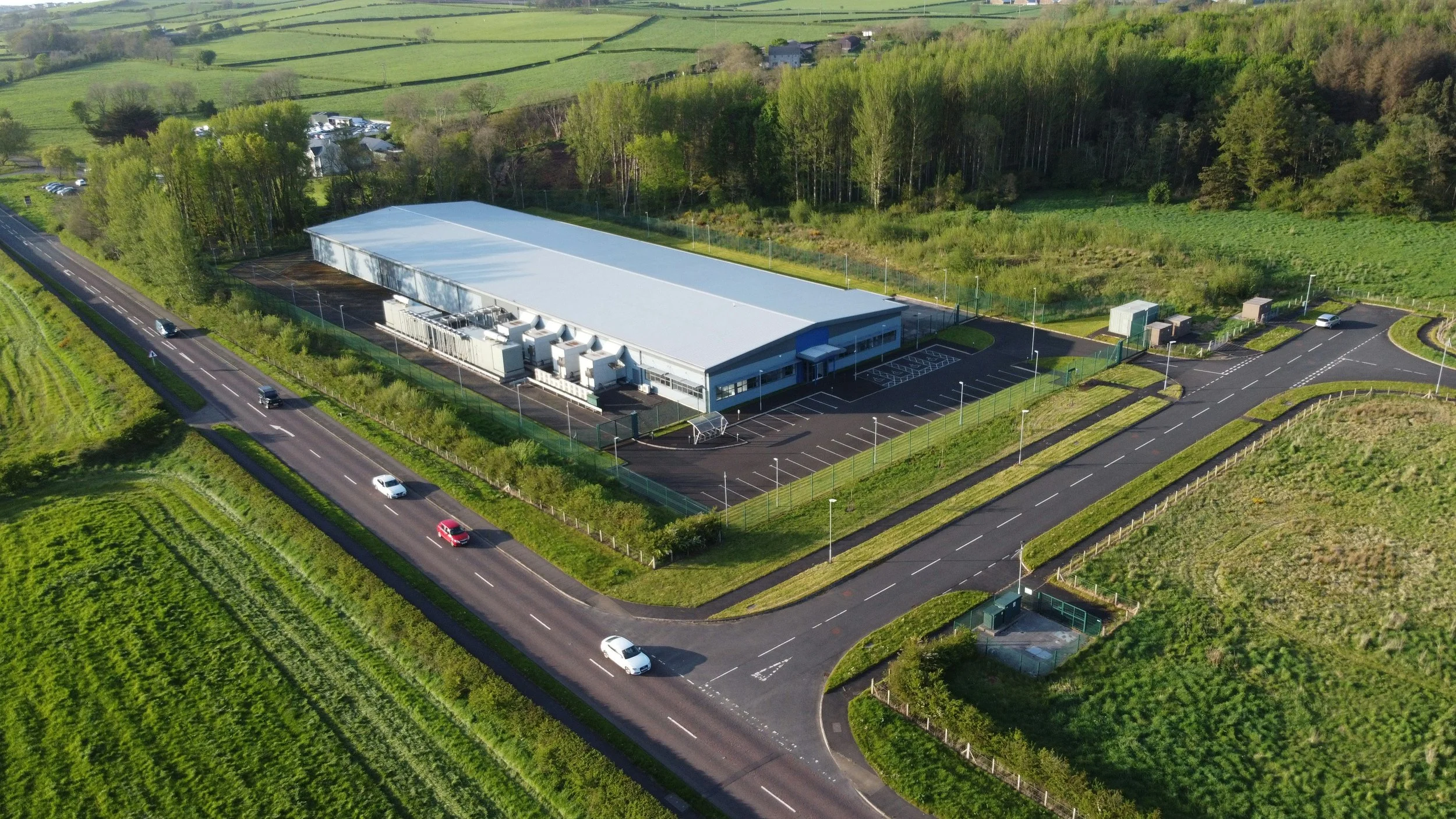
The UK's data centres currently consume around 2.5% of the country's electricity. By 2030, the House of Commons Library expects that figure to quadruple. At the same time, the government is fast-tracking planning for new AI data centre capacity, designating AI Growth Zones across Oxfordshire, Wales and the North East, and investing in the grid connections to power them. More infrastructure is coming. A lot more.
It is easy to read those two facts and feel a sense of unease. But the picture is considerably more interesting than the headline numbers suggest. The data centre industry is in the middle of a genuine transformation. This is not limited to simply optimising for environmental impact, but fundamentally rethinking what a data centre is for. The three most credible pathways to a sustainable data centre by 2030 are already being built.
1. Energy Efficiency: Doing More With Less
The primary metric for data centre energy efficiency is Power Usage Effectiveness, or PUE, the ratio of a facility's total energy consumption to the energy actually used by its IT equipment. A perfect score is 1.0, meaning nothing is wasted. The industry average has fallen significantly over the past decade, but there is still meaningful ground to cover.
The Climate Neutral Data Centre Pact, a voluntary initiative representing over 85% of European data centre capacity (backed by operators including AWS, Google and Equinix) has committed all signatories to a PUE of 1.3 or below for new facilities by 2030. For context, many older UK facilities still operate well above that target. Meeting it requires serious investment in how heat is managed.
That investment is increasingly going into liquid cooling. Where traditional air cooling systems circulate chilled air around server racks, liquid cooling delivers coolant directly to the heat source; the chips themselves. It is dramatically more efficient, and it can handle the power densities that the AI era demands. NVIDIA has forecast that AI-optimised server racks will reach 600kW by 2027, with early pilots of 1MW racks already under way. Air cooling systems, designed for a fraction of that density, simply cannot keep pace.
The honest caveat: efficiency improvements alone will not be enough. Global data centre electricity use is projected by the International Energy Agency to reach around 945 TWh by 2030, equivalent to Japan's entire current electricity demand. Doing more with less matters enormously, but it does not change the underlying direction of demand.
The numbers behind the goal
The Climate Neutral Data Centre Pact targets a PUE of 1.3 or below for new European facilities by 2030 — and 100% renewable energy matching across all signatories by the same date. The Pact covers more than 85% of European data centre capacity.
2. Renewable Energy: Matching Supply to Demand
The second pathway is about where the electricity comes from. The Climate Neutral Data Centre Pact's 2030 target is not just efficiency, it is 100% renewable energy matching across all signatory facilities. The 2025 interim target was 75% - an ambitious commitment, and meeting it is shaping where new data centres get built.
The UK government has been explicit about this. Its AI Growth Zone policy, published by the Department for Science, Innovation and Technology in November 2025, deliberately sites new data centre capacity near surplus renewable generation. Scotland, where wind output regularly exceeds the grid's transmission capacity, is receiving electricity price discounts of up to £24 per MWh for data centres built there. The first AI Growth Zone at Culham in Oxfordshire is being developed adjacent to the UK Atomic Energy Authority's site, with Small Modular Reactors planned for North Wales.
It is worth being precise about what 'renewable energy matching' means in practice. The dominant mechanism is Power Purchase Agreements, or PPAs. These are long-term contracts between data centre operators and renewable energy generators. PPAs provide price certainty for both parties and have helped fund the construction of new renewable capacity. But some analysts have questioned whether PPAs always drive genuinely additional generation, or whether they can function more like an accounting exercise, shifting clean energy credits without actually changing the carbon intensity of the grid.
3. Waste Heat: From Liability to Asset
This is the pathway that receives the least attention, and arguably signals the most significant shift in thinking about what data centres are.
Every server in a data centre converts electrical energy into heat. Traditionally, nearly all of that heat has been vented to the atmosphere, treated as an unavoidable by-product and disposed of as quickly as possible. But with liquid cooling systems now capturing heat at higher temperatures and with far greater precision, that calculus is changing. According to an analysis published by the Greater London Authority in June 2025, up to 95% of a data centre's IT load can theoretically be recovered as usable waste heat, given the right design and integration.
In the Nordic countries, this is already a mature industry. Microsoft's data centre campus near Helsinki is being developed as what the company describes as the world's largest waste heat recovery scheme. In Ireland, an Amazon data centre's waste heat is already supplying a district heating network in Tallaght, saving an estimated 1,100 tonnes of CO2 in its first year of operation alone.
The UK is earlier in this journey. London and Manchester have pilot projects under way, and the GLA has published detailed guidance on how data centre heat can be integrated into local heat networks. The government's AI Growth Zone policy paper explicitly identifies waste heat integration as a goal. But the UK's district heating infrastructure lags significantly behind Scandinavia, and most UK schemes are at the feasibility or early-deployment stage.
What matters is the direction. A data centre that supplies heat to local homes is not just a more efficient facility, it is a different kind of infrastructure asset entirely.
What 2030 Could Actually Look Like
A sustainable data centre by 2030 will look quite different from most of what has been built in the past decade. It will be more efficient, consuming meaningfully less energy per unit of compute. It will be powered primarily by clean electricity, matched on a tighter and more credible basis than today's annual averaging. And, in the more forward-looking examples, it will be contributing heat to the surrounding area, turning a liability into a community asset.
For organisations that rely on data centres, the question worth asking now is not whether the sector is heading in the right direction. It is: how well do you understand the sustainability credentials of your own digital supply chain?